Designed to survive. Not to thrive.
Most of us are preventing. Almost none of us are building.
Ask most people what it means to be proactive about their health and they will describe a GP visit they haven't yet cancelled, a skin check they keep meaning to book, a gym membership they almost use. They are describing prevention. The two words have collapsed into one idea, and that collapse is quietly costing us.
This is not a piece about semantics for the sake of it. The words we use to describe health shape the systems we build to deliver it, the behaviours those systems reward, and the relationship each of us has with our own body and its future. When prevention and proactive become interchangeable, the harder question never gets asked. And the only question worth organising around is this: what does a person actually flourishing look like, and how do we design toward it?
Three orientations, not one spectrum
To understand why the distinction matters, it helps to be precise about what each stage actually represents, and to recognise that reactive, preventative and proactive are not three points on a sliding scale. They are three fundamentally different orientations toward what health is and what it is for.
Reactive care responds to events. A diagnosis arrives, a crisis unfolds, and the system mobilises. This is where most healthcare funding and infrastructure still lives, for understandable historical reasons. It is also the most expensive point of intervention, and in terms of human experience, the least desirable.
Preventative care acts before the event but is still organised entirely around avoiding known negative outcomes. Vaccinations, bowel cancer screening, routine blood panels. These are genuinely valuable, and the people and systems that deliver them do important work. But preventative care shares an underlying logic with reactive care: health is primarily a disaster to be averted. The question driving it is what bad thing might happen, and how do we stop it. The orientation is still deficit-based. The north star is still an absence.
Proactive care asks a completely different question. Not what might go wrong, but what does this person's best possible health actually look like, and how do we move toward it? The orientation flips from avoidance to construction, from deficit to flourishing. It requires a different relationship with the person, a different set of metrics, and a different design philosophy entirely.
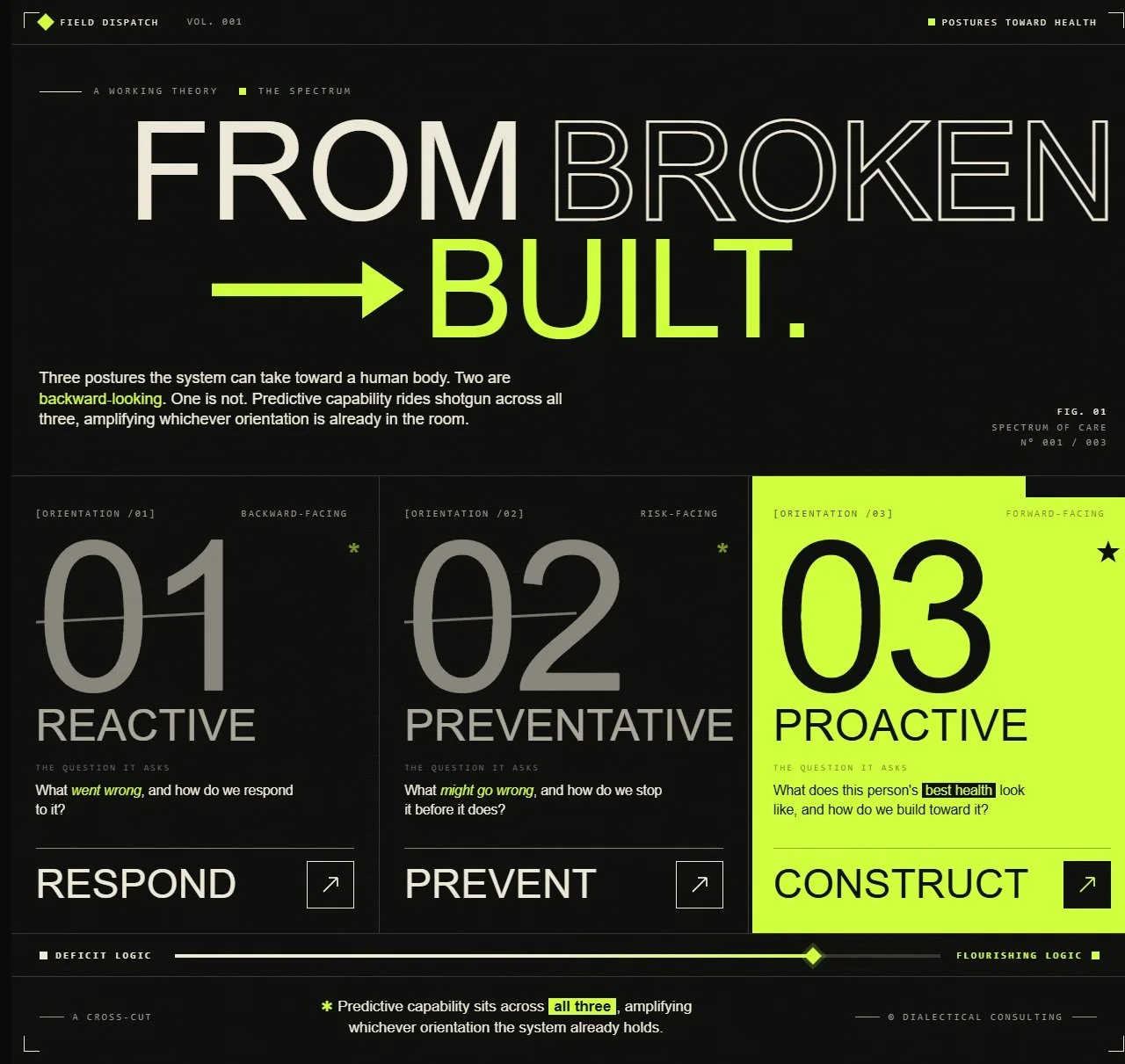
Between all three sits a capability, not a stage: predictive. Data, AI and biosensing technology are now sophisticated enough to identify patterns in an individual's health before symptoms appear, to personalise risk in ways that population-level screening cannot, and to model trajectories rather than snapshots. But predictive technology is orientation-neutral. Apply it with a reactive mindset and you get faster crisis response. Apply it with a preventative mindset and you get smarter, more personalised disease interception. Apply it with a proactive mindset and you start to get something genuinely new: real-time, individualised pathways toward a person's optimum. The technology does not determine which future you are building. The orientation does.
Why language is not a small thing
The conflation of prevention and proactive is not just imprecise. It is a structural problem, because language shapes what we build, what we fund, and what we measure.
When a health system describes itself as proactive but is still measuring success by disease rates avoided and emergency presentations averted, it has not changed its orientation. It has changed its marketing. The targets remain deficit-based. The design remains organised around stopping bad things. The person at the centre of the system is still being managed toward an absence, not supported toward a presence.
This matters for individuals too. When proactive and preventative mean the same thing in everyday language, the individual's orientation stays anchored in avoidance. Being proactive becomes a matter of not yet cancelling the GP appointment, of remembering sunscreen, of trying to drink more water. These are not bad things. But they are not what proactive health actually looks like, and the language gives people no map toward the alternative.
The nuance is not pedantic. It is the prerequisite for everything that follows.
The loop that connects everything
Getting serious about proactive health requires four things to shift simultaneously. They are not a checklist, and they are not independent levers. They form a loop, and each one depends on and reinforces the others, and pulling on any one of them without the others tends to produce something that looks like change but isn't.
Individual agency. For most people, the relationship with their own health is still fundamentally reactive or, at best, compliance-oriented. We do the recommended things to avoid the recommended outcomes. We respond to symptoms, to reminders, to diagnoses. Even the language of taking control of your health tends to mean checking the boxes more diligently, not building something deliberately. A genuinely proactive orientation requires people to have a picture of their own flourishing, a sense of what their best possible physical and cognitive life actually looks and feels like, and to orient toward that rather than toward a list of risks to avoid. That is a different psychological relationship with the body. It is harder, more personal, and more demanding than compliance. It also cannot be mandated from the outside. Systems can be designed to cultivate it or to suppress it, but it has to be owned by the individual to mean anything at all.
Systems design. Healthcare infrastructure funds and builds what it conceptually values. If the underlying concept is prevention, you get a system exquisitely designed to intercept disease, organised around population cohorts, risk stratification, screening intervals, and avoidable admissions. All of that is genuinely useful. But if the underlying concept shifts to flourishing, you need something structurally different. You need systems designed around longitudinal relationships rather than episodic encounters, around optimisation metrics rather than deterioration thresholds, around the texture of what a good life in a healthy body actually looks like for a specific person rather than a statistical average. Most health systems are not designed for that. Most are not even funded to ask the question, because the question resists the kind of short-term, quantifiable measurement that budget cycles demand. Changing the language without changing the design produces nothing. But changing the design without the language tends not to happen at all, because there is no shared vocabulary for what you are trying to build.
AI and data. For the first time, the technical infrastructure for genuinely proactive care at scale is within reach. Continuous biosensing, longitudinal health data, pattern recognition across populations and within individuals. These tools make personalised, dynamic, optimisation-oriented care possible in a way that simply was not true a decade ago. That is genuinely significant. But it also makes getting the orientation right more urgent, not less. The risk is not that the technology fails to deliver. The risk is that it delivers with extraordinary efficiency in the wrong direction, making preventative care faster, smarter and more targeted, and calling it proactive. Predictive tools pointed at a deficit model produce a more sophisticated deficit model. The technology amplifies the orientation. It does not replace the need to choose one.
Mindset. Underneath the individual, the system and the technology is a cultural question that rarely gets asked directly: what is health actually for? If health is defined as the absence of illness, then prevention is the appropriate goal and the system is already roughly organised around the right thing. But if health is understood as something more than that, understood as the presence of capacity, energy, resilience and the ability to live a life that is genuinely worth living, then the absence of illness is a floor, not a ceiling. It is the minimum condition, not the aspiration. That shift in understanding is partly philosophical, but it is not merely philosophical. It changes what you measure, what you invest in, what you design, and what you ask of the people you are trying to serve. It changes the story health tells about itself. And stories, in institutions as in individuals, tend to determine behaviour more reliably than incentives do. The mindset question is uncomfortable because it does not have a clean implementation pathway. It cannot be operationalised in a policy document or a product roadmap. But it is the thing that makes all the other changes coherent rather than cosmetic. Without it, you get better prevention dressed in new language. With it, you have a chance at something genuinely different.
What changes when we hold the distinction
None of this means reactive or preventative care becomes less important. They remain essential. People get sick. Crises happen. Population-level screening saves lives and will continue to. The argument is not that we abandon the earlier orientations but that we stop letting them define the ceiling of ambition.
The practical shift starts with a different question. For individuals: not what should I be avoiding, but what am I building toward? For health executives and system designers: not what outcomes are we preventing, but what does the person we are serving look like when they are genuinely well, and is our system designed to produce that? For technology and product builders: not how do we make prediction more accurate, but what orientation are we amplifying, and is that the one we intend?
These are harder questions. They do not resolve into clean metrics as easily as disease rates do. They require a tolerance for complexity and a longer time horizon than most systems are designed to hold. But they are the right questions, and the difficulty is not an argument against asking them.
The language is where it starts. Not because words are more important than action, but because the words we use determine which actions become thinkable. Prevention and proactive are not synonyms. Treating them as though they are is a choice, and it is one we can unmake.
If you are exploring the future of proactive health, healthcare strategy, AI, system design and how these intersect, let’s chat via info@dialecticalconsulting.com.au or contact me via LinkedIn.